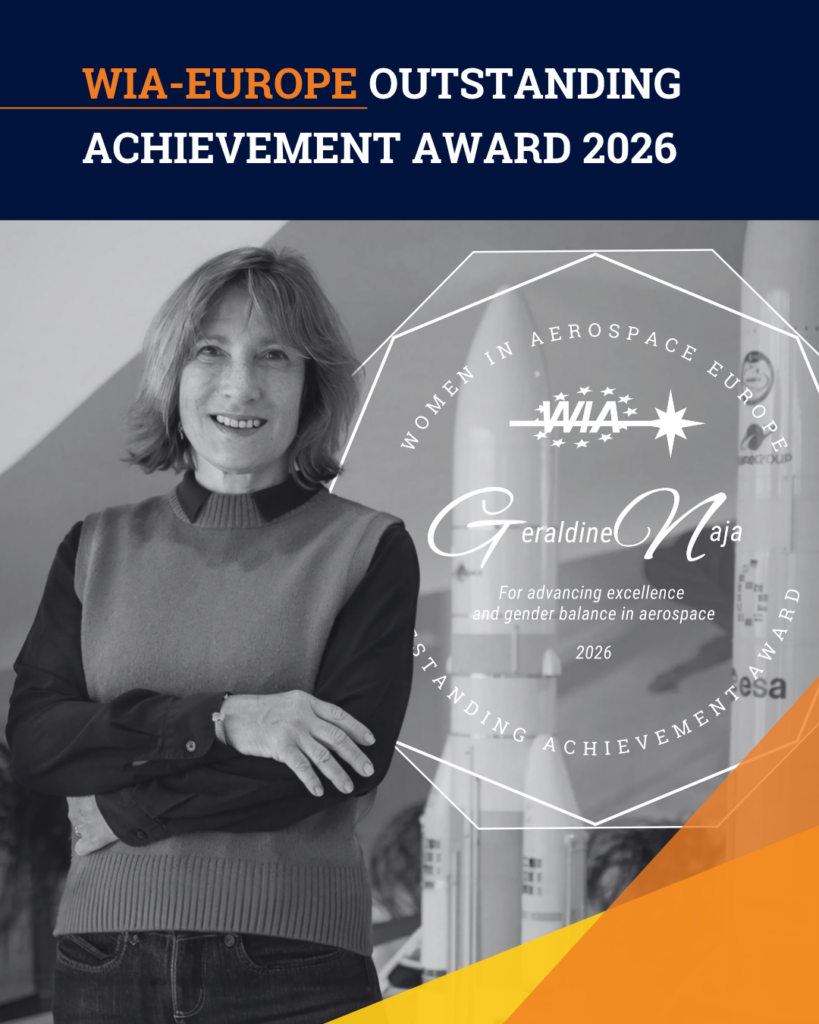
WIA-Europe is pleased to announce Géraldine Naja as the recipient of the 2026 WIA-Europe Outstanding Achievement Award. Discover more about Géraldine’s career, achievements, and contributions to the European space sector, and read our exclusive interview with her as she shares her career journey, the importance of mentorship, the evolving role of women in aerospace, and her advice for the next generation of space professionals.
Géraldine Naja was presented with the award at the International Astronautical Congress (IAC) 2026 in Türkiye, recognising her exceptional career, leadership and longstanding contribution to the European space sector.
Each year, WIA-Europe presents the Outstanding Achievement Award to honour individuals who have demonstrated exceptional accomplishments and leadership within the aerospace community. The award serves both as a tribute to outstanding achievement and as an inspiration to future generations. It comprises an engraved statuette and Honorary Membership of WIA-Europe, presented during an awards ceremony. WIA-Europe’s Honorary Members continue to support and enrich the WIA-Europe community through their experience and expertise.
A Distinguished Career in European Space
Géraldine Naja has dedicated nearly four decades to the European space sector. She joined the European Space Agency (ESA) in 1987 as a Payload Operations Engineer and has since held a wide range of strategic, managerial and institutional roles across the Agency.
Her career has included positions as Head of the Long-term Space Policy Office, Head of Strategic and Institutional Matters in the ESA Director General’s Cabinet, Head of the EU Relations Office, and Senior Advisor to the Director of Launchers. She also served as Advisor to the Cabinet of the French Minister of Research and Higher Education.
From 2015, she was Head of ESA’s Industrial Policy and Audit Department and subsequently took on leadership roles as ESA strengthened its focus on commercialisation and industry.
Until recently, Géraldine Naja served as Director of Commercialisation, Industry and Competitiveness, where she advanced commercialisation and competitiveness as strategic priorities for ESA, developing new approaches to strengthen Europe’s space sector and foster a more dynamic, market-oriented ecosystem.
On 1 April 2026, she took up her new role as ESA Director of Space Transportation, while continuing to serve as Acting Director of the Commercialisation and Industry Partnership Directorate.
Recognising Leadership and Impact
Originally from France, Géraldine Naja holds an engineering degree from École Polytechnique, a Master’s degree in propulsion and chemistry from ENSTA, and a Master’s degree in political science from Sciences Po Paris.
Through her career, she has combined technical expertise, strategic leadership and extensive experience in European space policy, industry and institutional relations.
An Exclusive Interview with Géraldine Naja
1. What initially inspired you to pursue a career in aerospace?
I chose a career in aerospace because of one of my teachers in fluid mechanics at my engineering school, namely Jean-Jacques Dordain, who later became Director General of the European Space Agency from 2003 to 2015. Instead of having us solve equations, he made us calculate the return trajectory of the Apollo capsule or the combustion rate of fuel droplets in microgravity. It was fascinating, and it gave many of us an immediate desire to work in the space sector. As for political science, I always loved history, especially international relations, and later on European matters. I wanted to complement my very scientific background with something broader, offering a different perspective for understanding our world.
2. What key actions, decisions or mentors in your personal or professional life helped you reach your current level?
Obviously, my first mentor was Jean-Jacques Dordain, whom I just mentioned. I have benefited from the mentoring and lessons learned from many colleagues, be they from ESA or elsewhere, among whom are the late Herbert Allgeier (former Director General at the European Commission), Jean-Yves Le Gall (former Director General of Arianespace and President of CNES), Giuseppe Morsillo, Eric Morel and of course, Josef Aschbacher, the current ESA Director General, who gave me the opportunity to become a Director. In my personal life, my father told me I could do anything I wanted to as a girl- and my mother showed me the importance of persistence and courage. I hope I can pass these messages to my two daughters, as well as to my younger ESA female colleagues. Passing knowledge and experience to the next generation is essential. Looking back, some of the best choices I made in my professional life were to embrace new opportunities and career changes when they arose, for instance, when I joined Minister and astronaut Claudie Haigneré as Senior Advisor in her Cabinet, or when I applied for (and became) Head of Department for Industrial Policy at ESA. These positions required new skills and represented big challenges, and I learnt a lot through them.
3. Looking back, if you had the knowledge and experience you have today at the start of your career, is there anything you would have done differently?
Maybe the only thing I would do – not differently, but at a different time -would be to apply for managerial positions earlier in my professional life, since I have enjoyed management more than anything else in my career. Working with my colleagues to build a team, seek out new talents, encourage team members to grow, and work together on challenges and projects towards success was and remains the most thrilling thing for me.
4. What challenges do you foresee in the near to mid-term future of the aerospace sector, and which key competences will be required to address them?
The sector will be facing several challenges. There will be many new actors and stakeholders coming from new countries, new companies with different ways of working, and new domains, such as new applications and customers – I would like to give examples of in-orbit services or AI in space. I also believe that space exploration, for commercial, security and scientific purposes, will further expand, requiring new technologies and a long-term vision of the future. The key competencies will include flexibility, curiosity and adaptability, but also an entrepreneurial spirit as well as strong competencies in systems engineering, since many new space programmes will encompass all sectors of space, from launchers and infrastructure to applications, operations, science or technology.
5. When meeting a young professional, what qualities first catch your attention?
Enthusiasm combined with thoughtfulness, the ability to listen, understand and question yourself, the sense of being part of a team rather than a mere individual, a good dose of humour, and curiosity about other topics besides and beyond professional matters.
6. What advice would you give to a young person who is considering a career in space?
Go for it! What else?! You will work on captivating and worthwhile topics; you will contribute to increasing knowledge for all humankind; you will meet great and diverse people from all countries, generations or genders; you will be required to be innovative and creative. There will be no or very few dull days, and you will never have to ask yourself why you chose to work in space, because it makes so much sense.
7. How does the situation of women in the space sector today compare with when you began your career?
It has changed enormously. When I started, it happened to me numerous times to be the only woman in a meeting. Like many women of my generation, I experienced my share of patronising remarks and inappropriate jokes. There were no female Directors at ESA and only a few female senior managers in technical positions. These days are over! However, I have seen greater change in national and European agencies than in the industry. The next step will be to see even more women in CEO positions in the space industry, and things have already started to change for example, Chiara Pedersoli at OHB, Aurélie Girou at Safran REOSC or Barbara Frei-Spreiter at Beyond Gravity – all of them women I admire.
8. What measures do you think are most effective for increasing the opportunities for women to grow into leadership positions?
Systematically ensuring that several women sit on all Interview Boards, since “same recruits same”, and training and recruiting women into senior management and leadership positions demonstrate that an entity, whether an agency, company or other organisation, considers women equally legitimate in such positions. I also think that new working conditions, such as telework or greater flexibility in working hours, when possible, are beneficial for both women and men in achieving a better balance between their personal and professional lives.
9. What is the most recent book, movie, talk/podcast, or article you encountered that impressed you, inspired you, or offered you a fresh perspective?
I really enjoyed the series “For All Mankind” which makes you wonder “what if the first human on the Moon had been a Soviet citizen rather than an American?” It also shows how space had a truly strategic dimension and can be a game-changer for our world. Other than that, my favourite recent book was “Cognitive Apocalypse” by Gerald Bronner, which reflects on how our free “brain time” has never been as high as today, with working hours having drastically decreased over the last decades, and asks why, despite this, our knowledge and intellectual capabilities are not necessarily increasing accordingly. At the same time our “brain time” is increasingly captured by algorithms, depriving us to some extent of our free will and influencing our thoughts and choices. It is a thought-provoking book, fortunately coupled with optimism!
10. What do you see as the most critical area for an association like WIA-Europe to focus on in the coming years?
Increasing the visibility of women in aerospace remains one of the most important priorities. Role models matter. They help inspire future generations of female students and professionals to pursue careers in space. It is a sector that offers wonderful career opportunities across many domains including science, engineering, economics, business, law, human resources, and whose doors should be wide open to women at every stage of their careers, including in leadership positions
Please join us in congratulating Géraldine Naja!