WIA-Europe’s Spotlight series features interviews with professionals across the aerospace and space sectors, highlighting their career journeys, expertise and perspectives on key industry challenges.
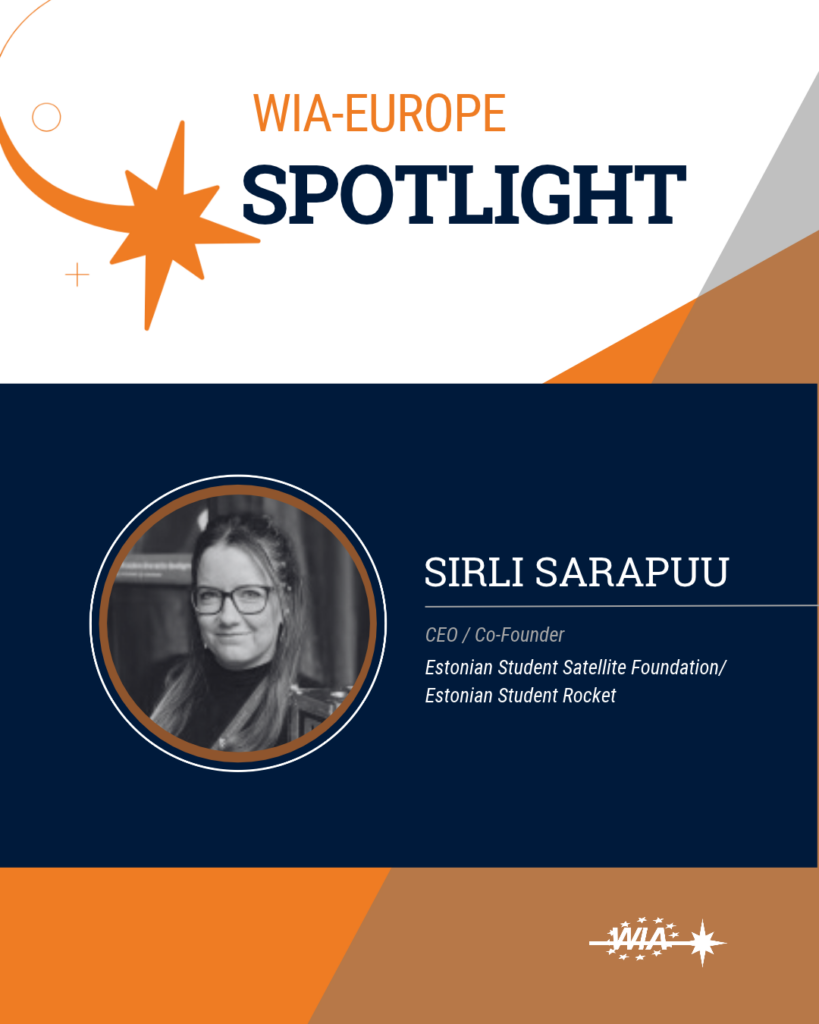
In this edition, Sirli Sarapuu, CEO of the Estonian Student Satellite Foundation and Co-founder of the Estonian Student Rocket Team, shares her insights on talent acquisition and retention, skills development and making the space sector more accessible to diverse backgrounds.
The interview follows the discussion on “Talent Acquisition and Retention in the Space Domain” at the 2026 Software Defined Space Conference in Tallinn, Estonia.
What first drew you to space?
I first became interested in space in high school. For a long time after, I never seriously considered joining the space industry. I went on to study event management in Birmingham, and then came back to Estonia to study marketing. When I was looking for an internship, I saw that Estonian Student Satellite was looking for a Communications Specialist. “Space sounds cool”, I thought, and applied. Today, I have been part of the team for almost five years.
What has continued to fuel your interest in the space sector?
In the case of the Estonian Student Satellite, I have been able to grow within the organisation. I started off as a Communications Specialist and eventually progressed to the role of Communications Lead. In addition, the Estonian space community is very small, so almost everyone knows one another. Over time, those professional connections often turn into friendships, too. These are the two main things which have kept me in the sector. And of course, space is also just very interesting.
As a communications professional, you are living proof that you don’t have to be an engineer to work in the space sector.
Definitely! When I first started, I knew very little about space technology – my technical expertise was very limited. Over the past five years, however, I have become more familiar with the technical aspects of space as well. Today, I can participate in more technical conversations with potential partners and feel confident to comment on some of the technical aspects of space projects.
You are the CEO of the Estonian Student Satellite Foundation and a co-founder of the Estonian Student Rocket Team. What motivates students to dedicate their time to these organisations, and what keeps them engaged?
What first seems to draw students towards space projects is that they seem “exciting and cool”. However, student satellite projects also offer hands-on experience, which can be very appealing for students, as university courses tend to be very theoretical. Participating in space projects also enables students to gain experience in project management or leadership. We also want to give students the chance to progress into more senior roles and expand their professional network – I believe that this has motivated some students to stay involved from the beginning of their Bachelor’s studies until the completion of their Master’s degree.
Where do you see space competing with other industries for talent, both in Estonia and Europe?
Looking ahead, the space sector is likely to face a growing shortage of skilled professionals, and I expect competition for talent to intensify between the space sector and other industries. Estonia’s space sector is expanding, with many companies growing their operations. This will create a growing demand for talent. However, established international companies are competing for the same engineering talent. In addition to specialists in space technology, the sector is also going to need more generalists – professionals who focus on the bigger picture and the broader context in which space activities take place.
Which particular skill will the space sector need most over the next five years?
Communication will definitely be one of the most important skills over the next five years; the ability to communicate clearly and effectively is essential, both within an organisation and when working with external partners. Being able to articulate what is needed, ask the right questions, and ensure that everyone is on the same page are valuable skills that will become increasingly important in the industry.
What is the first barrier you would remove to make space more inclusive for all backgrounds, ages and genders?
I have noticed that many roles in the space sector require specific academic qualifications, making it challenging to enter the industry without, for example, a Master’s degree. However, A Master’s degree or even a PhD does not necessarily make someone the strongest candidate when it comes to leadership or management. I believe that in today’s world, many skills can be acquired through different learning opportunities, whether through YouTube videos, online courses, or AI-powered learning platforms. Rather than placing too much emphasis on formal qualifications, I would encourage recruiters to focus more on candidates’ personalities and practical skills.
What are you most looking forward to at the Software Defined Space Conference in Tallinn on 27 to 29 October, and why should people join the talent panel on 29 October?
I’m most looking forward to the opportunity to exchange ideas on how space companies can become more attractive to students and future employees. I think the talent panel will be a great chance to discuss how we can bring new talent into the sector; it’s certainly going to be an interesting discussion. In addition, I’m also excited to reconnect with fellow Estonian space professionals – the conference is a great opportunity to catch up and hear about the latest developments in the sector.
What is the one question you wish more people in the industry were asking right now?
I think that space companies should be more curious about how to become more attractive to talent. How can companies encourage more students to pursue a career in the space industry, while also attracting professionals from other sectors who could bring valuable skills? This is also one of the topics we are going to address in the panel.
Sirli Sarapuu’s perspective highlights the importance of looking beyond traditional career paths to build a more diverse, accessible and sustainable space workforce. As the sector continues to evolve, attracting talent from different backgrounds and recognising transferable skills will be essential to its future.
Through this Spotlight Series, WIA-Europe continues to amplify the voices and experiences shaping the future of the European space sector.