WIA-Europe Roundtable Series: Women Trailblazers at the Living Planet Symposium 2025
Women In Aerospace Europe (WIA-Europe) hosted a four-part Women Trailblazers roundtable series during the Living Planet Symposium 2025, organised by the European Space Agency in Vienna, Austria. The events brought together exceptional women leaders from the fields of space, climate, industry, and innovation, with the discussions focusing on collaboration, climate challenges, technological advancement, and the future of the aerospace industry. Each session attracted a full room and sparked vivid exchange and networking among participants, highlighting the growing interest in gender equity and collaboration in aerospace and Earth observation.
These roundtables were the third of a series of events that WIA-Europe will continue to host at large international events, aimed at giving visibility to women experts in various STEM fields.

WIA-Europe Living Planet Symposium Programme:
TUESDAY, 24 June | 10:00 – 10:45 | STIMULATING COOPERATION
Panellists: Aarti Holla-Maini – Director, UNOOSA; Fani Kallianou de Jong – Climate Strategy and Delivery department, EBRD; Susanne Mecklenburg – Head Climate & Long Action Division, ESA; Rakiya Babamaaji – Director of NASRDA, Nigeria
Moderator: Luisella Giulicchi – Project Manager at ESA, President of WIA-Europe
- LinkedIn: Photos of the event>>

AARTI HOLLA-MAINI
Aarti Holla-Maini is the Director of the UN Office for Outer Space Affairs (UNOOSA), having taken up post on September 18 following her appointment by United Nations Secretary -General António Guterres.
Ms. Holla-Maini brings over 25 years of experience in the space and satellite sector, working predominantly with international organizations and regulators. Prior to the United Nations, she held the post of Secretary-General of the Global Satellite Operators Association.
Ms. Holla-Maini is a recognized leader with a strong track record in forging public-private and cross-sector partnerships; high-level advocacy at the international level; strategic communication and managing diverse stakeholders. Under her leadership, Ms. Holla-Maini expanded the association from being a regional organization to a global one representing commercial satellite operators around the world.
She was one of the chief architects of the Crisis Connectivity Charter established in 2015 for emergency telecommunications via satellite with the UN World Food Programme’s Emergency Telecommunications Cluster and has, on multiple occasions, secured recogn ition and policy support for space technologies to play their rightful role in connecting the unconnected, in Europe, Africa and beyond.
The appointment of Ms. Holla-Maini comes at a time when activities in space are being increasingly driven by the private sector. Her deep experience in high-level advocacy with international organizations and regulators, along with her understanding of the opportunities and challenges facing the space sector, will serve Member States well as they seek to access and leverage the benefits of space to accelerate sustainable development.
Ms. Holla-Maini’s experience has included service as a member of the World Economic Forum’s Global Future Council on Space; member of the Advisory Group of the Space Sustainability Rating managed by eSpace at EPFL Space Center; member of the Advisory Board of the Satellite Industry Association of India; Senior Space Policy Advisor to Forum Europe and an Expert Advisor on Space Traffic Management for European Union studies 2021-2023. Since October 2024 Ms. Holla- Maini is a member of the International Academy of Astronautics.
Ms. Holla-Maini holds a bachelor’s degree in law with German law from Kings College London and a master’s degree in business administration from HEC in France. She is fluent in French, German and Punjabi alongside her native English and has moderate knowledge of Dutch.
FANI KALLIANOU DE JONG
Fani Kallianou de Jong works for the European Bank for Reconstruction and Development (EBRD) in the Climate Strategy and Delivery department of the Bank. Fani focuses on supporting the green transition of the Bank and manages green economy financing as well as engaging on policy dialogue activities, gender equality and economic inclusion and she is leading in developing the Space Economy topic internally.
More specifically, Fani has been promoting the integration of space technology and space-related solutions for Climate Action, supporting SDGs as well as identifying business opportunities for potential space domain investments. She is the Chairwoman of the Space for Green Future Accelerator Working Group which has been spurred by ESA together with global green transition partners including the European Commission and other stakeholders and International Financial Institutions (IFIs).
She holds a degree in Economics and masters in International Business Economics from London City University, is an International Space University (ISU) alumni, and attended the Smart Space MBA Elective at the University of Oxford, UK.
Fani was born Greek in Hamburg, Germany and grew up in Brussels, Belgium. She is a keen polyglot and apart from English, she is fluent in French, Greek, Spanish, has a good command of Dutch and is learning Arabic.
SUSANNE MECKLENBURG
Susanne Mecklenburg leads the European Space Agency’s division on Climate and Long-Term Action, which is charged with promoting and increasing the use of Earth Observation (EO) data to strengthen climate science, applications and policy. Her team manages ESA’s Climate Change Initiative and the Global Development Assistance programme.
Susanne has a background in hydrology and atmospheric science from the Technical University of Dresden and ETH Zurich. Working for the UK’s Natural Environment Research Council, she led the UK’s EO Programme and served as the UK’s delegate to ESA. Previous to her current position she was the ESA mission manager for the SMOS, Sentinel-3 and FLEX missions.
RAKIYA BABAMAAJI
Dr. Rakiya Abdullahi Babamaaji (FGEOSON, MCOMEG) is a Deputy Director, Strategic Space Applications Department, National Space Research and Development Agency (NASRDA). Her expertise is in Geosciences, Water Resources, Environmental Assessment, RS and GIS etc.
She conducts researches amongst which are: Hydrological modelling and Land use Land cover (LULC) of Lake Chad Basin (LCB) supported by NASRDA/NSF/NASA, Hydrological modelling of Katsina-ala river basin: an emerging scenario from Lake Nyos threat supported by NASRDA/UMKC. Dr Rakiya was an intern from May – August 2005 with Canadian Space Agency (CSA), Commercialization Office (GRIP) and carried out research under Water Related Issues and Space application in Africa. She has also supervised and coordinated researches in the use earth observation technology in Agriculture, Eco-conservation, Disaster and Water resources.
She is the Vice chair of ITU/WMO/UNEP Focal Group on Global Initiative on Resilience to Natural Hazards through AI Solution. A member of Project Implementation Team (PIT) for Geo-referenced Infrastructure and Demographic Data for Development (GRID3) Nigeria. She is the coordinator, CropWatch Nigeria program. The NASRDA desk officer for World Bank Nigeria ACReSAL project. She is also one of two African Scientists invited into United Nations Disaster Risk Reduction Global Risk Assessment Framework (UNDRR GRAF) Steering Group. Dr. Rakiya was elected into the Africa Space Council at the 37th Ordinary Session of the Assembly of the Heads of State and Government of the African Union, held from February 14th – 15th, 2024. Dr Rakiya is also a Member of the Advisory Board of the EO AFRICA R&D Facility.
Dr. Rakiya holds a Doctorate degree in Geosciences and Civil Engineering from University of Missouri Kansas City, Missouri, USA, a Masters (MSc in Space Management from International Space University (ISU), Strasbourg, France and another Masters degree (MSc) in Environmental Resources Management from Lagos State University (LASU) Ojo, Nigeria and B.Tech in Geology, Federal University of Technology Yola, Adamawa, Nigeria. She has Certificate in Concept & Skill in Applied Earth Science Research from International Institute for Geo-Information Science and Earth Observation (ITC), Netherlands. She is a visiting lecturer with Institute of Space Science Engineering (ISSE), African University of Science and Technology (AUST) in Abuja, Nigeria and a Resource person for UN African Regional Centre for Space Science and Technology Education – English (ARCSSTEE).
Dr. Rakiya is a fellow of Geospatial Society of Nigeria (GEOSON) and a member of the following professional organizations too: Council of Mining Engineers and Geoscientists (COMEG), Nigeria Mining and Geosciences Society (NMGS), Nigerian Association of Geodesy (NAG), Nigerian Association Of Hydrological Sciences (NAHS), America Geophysical Union (AGU), Africa Women in GIS (AWiGIS), Africa Association of Remote Sensing of the Environment (AARSE), GMES & Africa Academic Network, Women in GMES & Africa etc.
WEDNESDAY, 25 June | 10:00 – 10:45 |THE CLIMATE CHALLENGE
Panellists: Catharina Bamps – Policy Officer EU Commission; Minoo Rathnasabapathy – Research Engineer & Program Lead at MIT Media Lab; Anny Cazenave – Scientist at LEGOS-CNES; Sarah Connors, Climate Application Scientist, ESA
Moderator: Luisella Giulicchi – Project Manager at ESA, President of WIA-Europe
- LinkedIn: Photos of the event>>

CATHARINA BAMPS
Catharina is a multi-lingual macro-economist and spatial planner with a distinguished academic and professional background. She holds a Master of Science in Economics, an Advanced Master in Urban and Spatial Planning from KU Leuven, and a degree in Export Management from the University of Antwerp.
She currently serves as a Policy Officer in the European Union’s Copernicus Earth Observation and Monitoring Programme. In this role, she contributes to the integration of geospatial intelligence into EU policy-making, particularly in areas related to environmental monitoring, climate action, and regional development.
Previously, she worked as a Geospatial Information Officer at the Joint Research Centre (JRC) of the European Commission in both Ispra (Italy) and Seville (Spain), where she was responsible for geospatial research in support of sustainable EU agricultural policy, regional development, transport, and climate change policy.
As a Senior Researcher at KU Leuven, she played a key role in several prominent European projects, including INSPIRE – State of Play, smeSpire, and the European Union Location Framework (EULF). These projects focused on the development of spatial data infrastructures across Europe and explored business opportunities for geo-ICT SMEs.
She also served as Secretary General of the European Umbrella Organisation for Geographic Information (EUROGI), where she established strong partnerships with major stakeholders, including EARSC, EURISY, NEREUS, the German Aerospace Center (DLR), the International Bar Association (Geoinformation Convention), national GI associations, and geo-ICT SMEs.
MINOO RATHNASABAPATHY
Dr. Minoo Rathnasabapathy is a Research Engineer and Program Lead at the MIT Media Lab. Her work is centred at the nexus of advanced technologies and policy to drive impactful solutions. Minoo’s research focuses on data-driven climate intelligence and the long-term sustainability of the space environment, applying the principle of circular design that integrates Earth’s stewardship with the safe and responsible use and exploration of space. Minoo’s work has been featured on CNN Business, BBC World News, and ABC News Australia.
Prior to joining MIT, Dr. Rathnasabapathy served as the Executive Director of the Space Generation Advisory Council, a global non-governmental organisation in support of the United Nations Programme on Space Applications.
Dr. Rathnasabapathy was responsible for leading the operations, business development, strategy, and policy output for SGAC. Dr. Rathnasabapathy earned her PhD in Aerospace Engineering from RMIT University, researching the impact dynamics of novel materials used in aerospace structures. She has served as a Fellow of the World Economic Forum’s Platform on Space Technologies, Member of the Global Future Council on Space, and as Vice President of the International Astronautical Federation from 2018-2021
ANNY CAZENAVE
Anny Cazenave is emeritus scientist at the Centre National d’Etudes Spatiales in France, and up to recently director for Earth sciences at the International Space Science Institute in Switzerland. Her research deals with the applications of space techniques to Earth sciences. In the first part of her career, she used space techniques to study geodetic problems (Earth rotation, gravity field, global Earth deformations) and marine geophysics. About two decades ago, she moved to climate research with focus in hydrology and sea level.
She contributed to this domain in using satellites to observe changes in land hydrology and sea level rise from global to local scales. She also contributed to the understanding of the processes (e.g., ocean warming, land ice melt, terrestrial water storage changes) causing global and regional sea level rise. Her current work also concerns sea level rise in the world coastal zones and the associated impacts. She was a lead author of the 4th and 5th Assessment Reports of the Intergovernmental Panel on Climate Change. She was awarded the 2020 Vetlesen prize.
SARAH CONNORS
Sarah Connors is a Climate Applications Scientist based at the European Space Agency’s in their Climate Section. Sarah manages many of the ocean related Essential Climate Variable projects at ESA, as part of their Climate Change Initiative. She also leads the team’s work on how earth observation can support climate change adaptation. Before ESA, she worked at the Intergovernmental Panel on Climate Change (IPCC) as the Head of Science Team for the Working Group I Technical Support Unit where she helped to publish many of the reports from the IPCC Sixth Assessment Cycle. Previously, she was Science-Policy Fellow at the European Geosciences Union, after completing a PhD researching methane emissions at a high spatial resolution in the UK.
THURSDAY, 26 June | 10:00 – 10:45 | INDUSTRY DAY
Panellists: Mariella Graziano – Executive Director of International Strategy and Development – Space Science, Exploration and Transportation at GMV; Mireia Colina-Fatjó – Business Development Senior Manager at INDRA; Odile Hembise Fanton d’Andon – ACRI; Monica Roca – Director/CEO at ISARDSAT; Moderator: Xenia Pattberg, WIA-Europe Chief Communications Officer
- LinkedIn: Photos of the event>>

MARIELLA GRAZIANO
Mariella Graziano is an Aerospace Engineer from the Sapienza University of Rome (Sapienza-Università di Roma). She joined GMV in 1999 and since 2022 she has held the position of Executive Director of Strategy and Business Development for Science, Exploration and Transportation – GMV Space Systems.
Currently she is Executive Director of Strategy and Business Development of Science, Exploration and Transportation – GMV Space Systems and member of the GMV-Alén Space Executive committee.
Mariella is an active member of numerous international associations, including the IAA Planetary Defence Committee, the IAF Committees for Space Exploration, Planetary Defence and NEO, and Industrial Relations, as well as the Global Exploration Conference. She has been part of the Board of Directors for Women In Aerospace Europe for STEAM and Education Outreach. She is member of Advisory Council of the Journal of Field Robotics and has more than 50 articles and publications in the space field.
Graziano is Academician of the IAA, The International Academy of Astronautics, Engineering Science.
From 2025, Mariella is “Maestra del Lavoro”, having been awarded by the President of the Italian Republic, Sergio Mattarella, with the “Stella al Merito del Lavoro”.
MIREIA COLINA-FATJO
Mireia Colina is a distinguished professional in the technology and aerospace industries, known for her significant contributions and leadership in various roles. She holds a double degree in Telecommunications Engineering from two prestigious institutions: Universitat Politècnica de Catalunya (ETSETB) and Politecnico di Torino (PoliTo). Over the course of her career, she has worked in renowned research centers and organizations such as ESTEC (European Space Research and Technology Centre), as well as in international companies including Leaf Space and GTD. Recently, Mireia Colina returned to INDRA Espacio as Business Development Senior Manager, where she continues to contribute to the growth and strategic development of the space and technology sectors.
Her career is marked by a deep expertise in both the technical and strategic dimensions of the aerospace industry. She has played a key role in advancing space-related technological initiatives, and specializes in identifying, developing, and managing business opportunities within the space sector. Beyond her professional achievements, Mireia is a strong advocate for diversity and inclusion in the tech industry. She is committed to creating a more equitable and representative ecosystem for future generations of professionals.
In recognition of her outstanding contributions and her commitment to gender equality, Mireia Colina was awarded the Premi Dona TIC in 2023. This prestigious award honors women who have made notable achievements in technology and innovation and highlights her role in enhancing the visibility and participation of women in the tech sector.
MONICA ROCA i APARICI
Mònica has a Master’s degree in Electronics & Telecommunications Engineering by the Universitat Politècnica de Catalunya. She is the Founder & General Director of isardSAT group, based in Catalonia and the UK (2006). isardSAT is a space research-intensive SME in the field of Earth Observation specialized in signal/data processing of satellite microwave sensors. Also co-founder of Lobelia, an isardSAT spin-off to address climate emergency, using EO data and climate projections. Mònica is a Senior Engineer and Scientist with more than 25 years of experience in scientific, technical and managerial aspects of Altimetry. From 1995 to 2004 she worked at the European Space Agency (ESA/ESTEC), responsible for the RA system onboard EnviSat. PhD candidate from 1997 at TUDelft. She is author of numerous scientific papers and scientific books chapters. In March 2021, she was elected President of the Barcelona Chamber of Commerce. She is also the President of its Space Commission since June 2019.
Susanne has a background in hydrology and atmospheric science from the Technical University of Dresden and ETH Zurich. Working for the UK’s Natural Environment Research Council, she led the UK’s EO Programme and served as the UK’s delegate to ESA. Previous to her current position she was the ESA mission manager for the SMOS, Sentinel-3 and FLEX missions.
ODILE FANTON D'ANDON
Odile Hembise Fanton d’Andon is a French environmental researcher, co-founder and CEO of the company ACRI-ST which leads an international consortium of independent organizations working together to better understand and monitor the Earth’s
environment. Odile Fanton d’Andon was the recipient of the Irène Joliot-Curie Prize in the category “Women, Research and Enterprise” in 2021 for her work.
Odile Fanton d’Andon holds a Master’s degree in Applied Mathematics from the University of Nice – Sophia Antipolis, a DEA from the Ecole des Mines de Paris, and a PhD from Sorbonne University (Paris VI). Her PhD work at CEA Saclay was part of a major
international project to explore the unknown seabed of the North Atlantic Ocean.
The work of Odile Fanton d’Andon has focused on methods and products derived from combinations of satellite observation, numerical modelling and in situ measurements. She co-founded the French company ACRI in 1989 to create a way to bring together
experts in the fields of mathematics, physics and fluid dynamics and collectively gain a better understanding of the Earth’s environment. The company specializes in remote sensing from space, transforming the collected data transmitted by satellites into
information, and integrating that knowledge in research using the processing and interpretation tools developed by the company.
In 2000, she co-founded and became CEO of ACRI-ST, the operating company of ACRI. ACRI-ST leads an international group of eight independent organisations in seven countries, which combine the talents of their 200 researchers and engineers. The operational companies secure, improve and deliver quality data and insights for understanding climate change, the environment and the universe to make informed decisions. Its IT capabilities are among the highest in Europe on the private cloud for producing, archiving and distributing georeferenced data.
FRIDAY, 27 June | 13:45 – 14:30 | FRONTIER OF TECHNOLOGY
Panellists: Anna Maria Trofaier – Cryosphere Scientist at ESA; Anna Jungbluth – Research Fellow at ESA; Rosie Willatt – Climate Lead and a Lecturer at UCL Department of Earth Sciences; Valeria Gracheva – EO Microwave Payload Engineer, ESA
Moderator: Gülin Dede, ESA Space Segment Engineering Coordinator
- LinkedIn: Photos of the event>>

ANNA MARIA TROFAIER
Dr Anna Maria Trofaier is an Austrian physicist and cryosphere scientist working for the European Space Agency. Anna Maria studied Astrophysics at the University of Edinburgh (2008), followed by an interdisciplinary master’s degree in Environmental Technology and International Affairs at the Vienna University of Technology and the Diplomatic Academy of Vienna (2010). She was awarded a PhD degree in Polar Studies from the University of Cambridge (2014). Her expertise is in radar remote sensing of the polar landscape. Prior to joining ESA, she spent fifteen months in the High Arctic managing a downstream satellite service for researchers based in Svalbard. Anna Maria has served in several roles at ESA. In her current post she is responsible for all research and development activities related to geophysical retrievals of satellite data for climate data records to monitor sea ice, glaciers, ice sheets and snow.
Anna Maria is a member of the Institute of Physics in the UK. In her spare time, she volunteers for Girls on Ice Austria – an all-female glacier expedition that aims to empower young women, build confidence, and encourage them to pursue careers in STEM. Anna Maria is also a community representative for the Cystic Fibrosis (CF) Trust’s Innovation Hub for Lung Health and Infection to provide community guidance for research, to support translational efforts to bring basic science discoveries closer to those affected by CF, and to raise awareness of this rare genetic disease.
ANNA JUNGBLUTH
Anna Jungbluth is currently working as a Research Fellow in the Climate and Long-Term Action Division of the European Space Agency (ESA) developing machine learning (ML) models for Earth Observation and Climate research. Her research focuses on self-supervised learning, foundation models, and instrument-to-instrument translation to create long-term homogeneous data records of satellite observations. Before joining ESA, she earned her PhD in Physics from the University of Oxford, researching renewable energy and photovoltaics.
Anna developed an interest in ML for science through an internship with the NASA and ESA-funded Frontier Development Lab research programme, where she worked in an interdisciplinary team of researchers to develop ML models for studying the Sun and Earth. Anna is passionate about increasing diversity in STEM and helping to empower the next generation of interdisciplinary scientists.
ROSEMARY WILLATT
Rosemary Willatt became a Lecturer in the department in 2024. She studies sea ice in the polar oceans which plays key roles in Earth’s climate. She conducts experiments in cold laboratories as well as on Arctic and Antarctic sea ice to advance our understanding of the physical properties of snow and ice and capability to monitor polar Essential Climate Variables via remote sensing, for example using satellite radar altimetry data used to estimate sea ice and snow thickness. She plans and conducts polar field campaigns, analyses geophysical and radar data from surface-based, airborne and satellite instruments and advises space agencies on Earth Observation satellite mission development.
One of her current focuses is on development of a novel technique for estimation of snow depth on sea ice, and the European Space Agency (ESA) awarded her the inaugural Konrad Steffen award for a presentation on the early stages of this work. She is now Principal Investigator (PI) of an ESA-funded project developing the Polarimetric Synthetic Aperture Radar Altimeter (PoSARA) concept.
Rosie is also the PI for Sea Ice Earth Observation at the Centre for Polar Observation and Modelling, and a champion for EDI and sustainability.
VALERIA GRACHEVA
Valeria Gracheva studied Electrical Engineering and Information Technology at RWTH Aachen University in Aachen, Germany
from 2004 until 2009. From 2010 until 2016 she worked at Fraunhofer Institute for High Frequency Physics and Radar Techniques FHR in Wachtberg, Germany as a research scientist. During that time she also did her PhD at the University Siegen in Siegen, Germany. The topic of the PhD was: “Multichannel analysis and suppression of sea clutter for airborne microwave radar systems”.
After that she worked as a PostDoc at the University of Alaska in Fairbanks, Alaska, USA. From 2018 until 2021 she worked at the
Microwaves and Radar Institute of the German Aerospace Center in Oberpfaffenhofen, Germany. Valeria joined ESA in 2021. She is the payload engineer of Sentinel-6 Next Generation and Earth Explorer 12 Hydroterra+ during Phase 0 . Further, she is the technical officer of CRISTAL’s airborne demonstrator CRISTALair and several other pre-development activities.
ADDITIONAL HIGHLIGHT: Women Trailblazers @ SPACE IN THE CITY
In addition to our roundtable series at the Living Planet Symposium, WIA-Europe proudly contributed to the Trailblazers session at SPACE IN THE CITY, an open-air festival bringing space to the public in the heart of Vienna. The concept of our Women Trailblazers series was adopted by the event organisers, and the speakers were proposed by WIA-Europe – continuing our mission to elevate the visibility of women space experts and reach broader audiences beyond the professional community.
The lineup featured inspiring voices including:
- Pascale Ehrenfreund, President of the Committee of Space Research (COSPAR) and Research Professor of Space Policy and International Affairs at the Space Policy Institute/George Washington University in Washington DC
- Judith Delany, Founder of Perihelion – Space Communication, Consultation and Matchmaking
- Sarah Connors, Climate Applications Office, ESA Climate Office
- Julia Wagemann, Co-Founder thriveGEO & Women+ in Geospatial
The event attracted a diverse and engaged public audience and extended the momentum of #LPS2025 into the city.
- LinkedIn: Announcement and Photos of the event>>
For more information on the event, visit the Living Planet Symposium 2025 website.
We look forward to seeing you there!
Previous Women Trailblazer Events

Women Trailblazers: Roundtable – Entrepreneurship in an Evolving Aerospace Ecosystem
We invite registered visitors of the 10th CEAS Aerospace Europe Conference & 28th AIDAA International Congress in Turin to join us for a roundtable discussion.

Women Trailblazers: Roundtables at the Living Planet Symposium 2025 in Vienna
We invite registered visitors of the Living Planet Symposium 2025 in Vienna to join us for a series of Roundtable discussions.
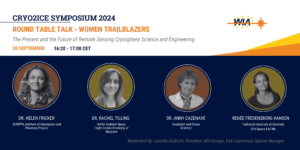
Trailblazing Women: The Present and the Future of Remote Sensing Cryosphere Science and Engineering
The second session of the WIA-Europe Trailblazers Round Table Series will take place on 26th of September during the Cryo2Ice Symposium 2024.
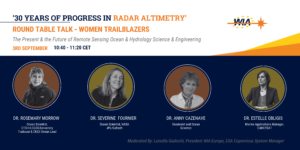
Trailblazing Women: Shaping the Future of Remote Sensing, Ocean, and Hydrology Science
’30 Years of progress in radar altimetry’ Symposium